Sunday, February 1, 2009

Max's Review...

... has moved to WordPress.

I've been using Blogger (Google) to post movie reviews for nearly a year. I've decided to try out WordPress.com, because its layout is generally more intuitive, backups are much easier to handle, and it provides some other benefits that Google simply doesn't have. Thank you for visiting my blog, and I'll see you at the new site!

The URL:
http://maxsreview.wordpress.com/

Best,
Max

Friday, January 23, 2009

Short Cuts #1

I've been pretty distracted over the last month, what with winter break and my first week of school. This is my first attempt to play catch up, with several brief reviews of some films that I've seen this week.


“Sans Soleil” (1982) is a challenging, though highly rewarding, film: it's a mish-mash of ideas about modern culture, set predominantly in Tokyo, and conceived around a narrated series of letters, by the director Chris Marker. The film is hard to fit into one category, because it's an essay and a documentary that also ventures into the avant-garde. Its images are fascinating: they range from the beautiful (a dog lying on a beach) to the graphic (a giraffe getting shot three times: in the haunch, in the neck, and finally in the head), to the ostensibly banal activities of residents in Tokyo. Tied to Marker's brilliant narrative, the images become something even more powerful: they represent a mere approximation of Marker's memories. But this self-organization of what goes on in one's life is something that we also engage in, because reality, as “Sans Soleil” helps us to realize, is just a collection of sketches in our minds. Marker says that there is a “degree of truth in banality.” And while we struggle to understand our place in our own world, Marker is kind enough to offer us an exceptional view into his own. (First viewed on 1/22/09, in 35mm projection at the PFA.)


“Nanook of the North” (1922) is an early documentary, by Robert Flaherty, about the life of an Eskimo... with a really long name that Flaherty simplified to "Nanook." I've seen it twice, and both times I've fallen asleep for long stretches because it's so boring; and because it treats its subjects as, literally, "happy-go-lucky" and "simple" people. (Second viewing on 1/20/09, on a DVD in class.)


“The Broadway Melody” (1929) was MGM's first musical; critics at the time considered it one of the best early sound films, considering the technical limitations that filmmakers endured during the transition from silent cinema to sound. (The difficulties in making a sound film were mocked twenty-something years later in MGM's “Singin' in the Rain”). It won the Oscar for Best Picture, but, really, this film is terrible. The story is unambitious and stupid - it centers on two annoying women who try to get into show business. The dialogue is very stilted, there's essentially no camerawork, and the action is shot from far away because cameras had to be kept in cumbersome soundproof boxes. Plus, there's a very nasty depiction of an extremely stereotypical gay man, who serves as the theater's tailor. It made me feel so angry – I now have some idea how black people - or typically stereotyped members of any race, religion, and/or sex, for that matter - must feel when they see how they've been depicted in early films. (First viewed on 1/20/09, on a DVD in class.)

Saturday, January 3, 2009

Doubt

"Doubt"
John Patrick Shanley, 2008


“Doubt” is the film adaptation of a play about a priest who is accused by a Catholic school's principal of sexually abusing a student. In the film, the priest is played by Philip Seymour Hoffman, the severe principal by Meryl Streep, and a nun, given the unfortunate and dull role of a pawn between the two contesting powers, by Amy Adams. The problems with “Doubt” arise from its translation from a play to the screen – or, rather, the lack of much of a translation. The film is set up as a series of arguments between two to three characters within a single setting; this technique works well on-stage, but not in a film. The interactions are interesting initially, at least, but not after an hour of hearing the same issues ad nauseam: Streep's nun repeatedly states that she suspects the priest is “doing something” with the boy, but this action is never explicitly stated; the act is instead relegated to excessive implication.

At its best, “Doubt” presents us with an interesting conflict between two mindsets: one that wants to be more receptive of changes in secular society, as represented by the priest, and one that fiercely defends the status quo, as represented by the principal. Streep plays her character to the extreme, so much so that she nearly transcends the movie – her principal comes across as more of a spectacled specter than a real person. Much, or perhaps most, of her hatred for the priest stems from his “unorthodox” practices, which include being protective of the school's only black student, who is, as it turns out, also the student he is accused of abusing. Most important, then, is the way that the film presents the priest's culpability. From what I have heard, the play leaves the priest's culpability to our imagination – in other words, it leaves us doubtful of his actual culpability. The filmmakers, however, are less keen on the power of ambiguity. There is a telling shot of Hoffman's priest bashfully glancing upwards at a cross, which obviously paints him as guilty – Hoffman does his best, but he's never given a chance.

5.5/10

First Viewed: 12/17/08, in 35 mm projection - IMDb

Friday, December 26, 2008

The Curious Case of Benjamin Button

"The Curious Case of Benjamin Button"
David Fincher, 2008


Why are filmmakers so obsessed with exposing our vulnerability and temporality? This year, we have seen at least two serious attempts at exploring these hefty concerns. The first is Charlie Kaufman's “Synecdoche, New York,” which centers on a brilliant artist who tries to overcome artistic and personal impediments. The second is David Fincher's latest film, “The Curious Case of Benjamin Button.” The latter is about a man named Benjamin (Brad Pitt), who is born in New Orleans, at the culmination of World War One, in 1918, as an old man who ages backwards.

It's a wonderful, intricately made film, though it's so precisely constructed that its characters are left somewhat emotionally sterile. But I think that this is Fincher's point - that people are subject to circumstances that lie beyond their control. Much of Benjamin's journey consists of simply running into interesting people, many of whom are full of regret, and seeing what cards they have been dealt – and how they deal with their circumstances. He befriends a bored, middle-aged woman named Elizabeth (Tilda Swinton), who attempted to swim across the English Channel, only to find that the current was so strong that she had to give up on her dream within two miles of France's shore. In one beautifully engineered sequence, Fincher illustrates how Benjamin's love interest, Daisy (Cate Blanchett), who was a dancer, could have continued her successful career had the taxi that ended up hitting her driven by five minutes earlier, or had the driver stopped for coffee; and so on. Thus we get the fascinating, if somewhat sobering, notion that people are defined largely by their experiences, rather than necessarily being fascinating in themselves.

Like “Zodiac” (2007), “The Curious Case of Benjamin Button” feels a bit too long. But Fincher has a keen sense of visuals and of pacing that helps to keep his nearly three hour movie interesting. The film has a curious self-reflexive quality: there is a visual motif involving a clock running backwards, while Benjamin's life moves ahead, and a running gag involving an old man that tells a story about how he was struck repeatedly by lightning (we see grainy, degraded clips that depict these events). Paolo Cherchi Usai, in his book The Death of Cinema, describes film itself as a temporal thing, and as much a subject to time as the characters it chronicles. But if one's life and the medium on which it is recorded – be it film, or the diary on which Benjamin's story is chronicled – is subject to deterioration, and, ultimately, destruction, the most that we can hope to expect is that that the experience itself is memorable. Fortunately for us, it certainly is in Benjamin's case.

Given the sheer amount of detail and characters that Fincher chronicles in Benjamin's unusual journey, it is surprising how poorly he approaches a couple of essential elements in his film. The framing narrative, which takes place in a hospital, with Daisy on her deathbed and her daughter reading Benjamin's journal, feels awkward; and whenever Fincher cuts to it, it takes us out of Benjamin's narrative. And then there's his approach to the prospect of Benjamin, now an old man – in a young man's body – having a child with Daisy. Benjamin feels that he wouldn't be a good father because he would basically be a kid while his child grew up; but he fails to mention how he's matured and developed during his sixty-or-so years of life – he ends up leaving Daisy anyway. It feels like a bit of a cop-out. But as we find out by the end of the film, Benjamin, like the other fascinating people that he befriends, holds similar long-lasting regrets about this very decision, which, admittedly, lies largely outside of his control.

8/10

First Viewed: 12/25/08, in 35 mm projection - IMDb

Wednesday, December 24, 2008

Interview with the Vampire

"Interview with the Vampire"
Neil Jordan, 1994


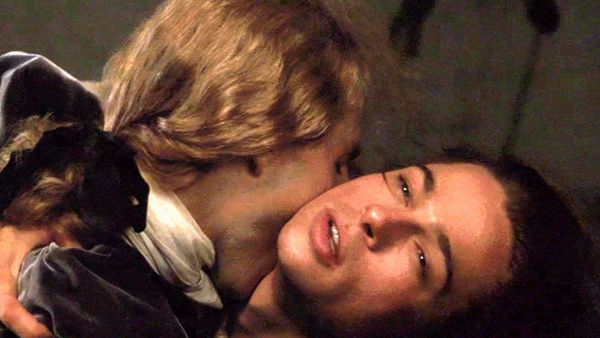
“Interview with the Vampire,” which is based on a novel by Anne Rice, has a very simple and predictable narrative, which is kind of strange considering its bizarre subject matter. Brad Pitt plays a vampire who gives an account of his centuries-long life to a reporter (Christian Slater). Pitt used to be a plantation owner from New Orleans, but after the deaths of his wife and daughter, he spent his days gambling away his money, because he didn't care about life anymore. This is where a Parisian vampire, played by an unintentionally hilarious and over-the-top Tom Cruise, enters – and it is only when Pitt becomes a vampire that he finally appreciates the life of a normal person.

A character's new-found appreciation for life is a potentially interesting theme, but since we don't really know much about Pitt's past and how his life really became different once he turned into a vampire, this essential part of the movie doesn't resonate with us. We instead turn to other aspects of the film, most of which turn out to be inadequate. The set design, the makeup, and many of the visuals are excellent. Everything else, including the acting, the story, and the silly ending, in particular – not so much.

5/10

First Viewed: 12/24/08, on Blu-ray Disc - IMDb

Monday, December 22, 2008

The Get-Together

The Get-Together

We pass through dim stretches of freeway, on average four lanes across, before reaching our destination. Except that it takes several passes down a cul-de-sac before we actually find the right house. They all look the same, and it doesn't help that it's dark – and that my dad, who's driving, punched in the wrong address on Google Maps. But he decides to park in front of the one home with its lights on and with people going in and with a large, inviting sign that says “Happy Hanukah!” As it turns out, he guesses correctly.

I find get-togethers to be awkward affairs, particularly when they involve older people who I don't know. There's a crush of them by the food in the kitchen. They know my parents and my brother and sister, but not me. But I look like my dad, and I'm as tall and lanky as my younger brother, both of whom this crowd is familiar with, so I'm not without company. I engage in some conversations, which go pretty well until I mention that I'm a Film Studies major. This usually elicits two responses: one, the person pretends that this is a good thing – “how interesting” – and moves on, unless, on the rare occasion, they talk about their favorite film and explain why it worked for them; or two, the person asks me what I'm going to do with such a major. In other words, how am I not going to starve after I finish college? I give them the three half-baked options I'm currently considering – applying to law school, getting involved with films (in cinematography or post-production), or teaching. The person flashes a grin and says something, like, Well, I didn't know what I was going to do when I was in college either. And then, with nothing left to say, both people have to move on. But for some reason, neither person can look the other in the eye and say, “I have nothing left to say to you.” What ends up happening is the other person and I smile at each other for a while, or one of us says that we have to grab food, or we just drift our separate ways.

I start piling food from the buffet onto my plate, until my mom comes over to warn me that it's not being served yet, though it's already, technically, being served by me. Well, that makes me sound like a jerk. But I usually am when I'm hungry. People begin lining up at the buffet, and I get in line. A tall man cuts in front of me, and I tell him that I was in line before him. He deflects my direct statement with a very dry one – “You'll remember me as the prick who cut in front of you” – that only somewhat obscures what he really thinks I am, and cuts behind me.

I actually knew a few of the people there before tonight's get-together. There's Hannah, who was in our synagogue's then-makeshift teen choir with me. She's in the middle of wrapping up college applications, which she finds exhausting, and she hopes to get into Carnegie Mellon. She still goes to religious school, in large part because she loves our cantor, who I never got all that close to for some reason; maybe it's because I sensed that she didn't really like me, even though I enjoyed singing in the choir. I can't really say. There's Samara, a blond-haired girl who was also in the choir with me, and who's also finishing up her applications. There's Penny, the daughter of a member on our synagogue's board of directors, who keeps her hair cut short and has an unusually sweet smile. She's tired of the shallow, arrogant and sheltered people at her private school, and she wants to get out of California. She's a member of her school's GSA (Gay-Straight Alliance). We have a very stimulating conversation.

I lean against the wall, eating chocolate cake with a fork in one hand and cradling my empty plastic cup between an armpit as I listen to some members of the choir sing “Poisoning Pigeons in the Park,” a highly amusing song by Tom Lehrer. Finally, we leave the house and walk to our car. It's hard to see. There are only two streetlamps to light the way.

Friday, December 19, 2008

The Double Life of Veronique

"The Double Life of Veronique"
Krzysztof Kieslowski, 1991


Watching “The Double Life of Veronique” is like trying to solve a puzzle, but without such nuisances as burgeoning frustration or headaches. No, this is one of those films that is stunning because of its quietness, its challenging yet simple narrative, and its patient pacing. The film centers on two women, who may be identical twins, named Veronique, both of whom are played by an outstanding Irene Jacob: one of them is a promising singer in Poland and the other is a teacher in France. Neither of them know that the other exists. But when one of them suddenly dies, we switch to the narrative of the other Veronique, who is in the middle of having sex with her boyfriend.

The director Krzysztof Kieslowski likes to play with this idea of opposites, and how two extremes really aren't so far apart. We witness, for instance, this link between pain and sex, and death and life, when we first see the other Veronique, who inexplicably feels saddened post-coitus, because she feels that she's lost someone she knows. And for the rest of the film, Veronique attempts to figure out who or what she has lost. Kieslowski and his cinematographer Slawomir Idziak (“Black Hawk Down”) craft an impeccable visual world, complete with a red and green color palette and numerous reflections, that reveal Veronique's confusion, while making the notion of the double all the more apparent.


Veronique's journey is really one of self-discovery, about a woman trying to figure out who she is, even though she inhabits a world that seems to lie much beyond her control. But there is also a somewhat self-reflexive quality to the film; it feels like it is as much about Veronique's story as it is about us being able to look in on her life. It is no accident that a love interest of hers is a puppeteer, Alexandre Fabbri (Philippe Volter), who himself involves her in a playful scheme of his. In one memorable sequence, Veronique, clad only in her underwear, walks up to a window, touches the glass with her hand, and closes her eyes. It is then that we realize that she is yearning for something inexplicable, something, perhaps, that lies beyond her limited, filmic world. But we, the viewers, are merely on the other side of the looking glass. Rarely have I felt so close to and so far away from a character. Rarely has this boundary between reality and artifice been so vaguely and so clearly delineated.

10/10

First Viewed: 12/19/08, on a lovely Criterion DVD - IMDb

Monday, December 15, 2008

Duly Noted: Live Free or Die Hard and Les Choristes

Duly Noted
"Live Free or Die Hard" and "Les Choristes"


“Live Free or Die Hard,” being the latest film in the franchise that gave us the classic action film “Die Hard” (I have not seen the other two sequels) is the type of of movie that you try your best to enjoy. It features Bruce Willis as the bad-ass super-cop, John McClane. It's supposed to offer great action sequences, some fantastic one-liners, and great villains; in short, it has the potential to serve as perfect entertainment. The problems I have with “Live Free or Die Hard” are similar to those I have after listening to Coldplay. Their songs are catchy and easy to listen to, but I find them so inane and boring that, after listening to one of their songs, I ask myself why I chose to do so in the first place. I felt the exact same way after watching “Live Free and Die Hard.”

The movie, which is directed by Len Wiseman, the man behind “Underworld” and “Underworld: Evolution,” the other two films in his limited canon, has the following premise: a computer genius and villain with the utterly uncreative bad-guy name Thomas Gabriel (Timothy Olyphant) is angry when leaders in the U.S. ignore his calls to revamp the security of the computer networks upon which the country relies. In retaliation, he decides to bring the country to its knees by controlling everything through computers, hiring a sizable team of thugs to carry out his dirty work, and teaming up with his lover, a martial-arts specialist named Mai. Oh, and McClane gets involved when the Feds send him to rescue a ditzy computer hacker named Matt Farrell from Gabriel's thugs.

It's an utterly ridiculous plot, and I don't mind that in the least. What bother me most is that an evil plan involving a villain that gains control of everything is, by its nature, dull. One could argue that the premise of “Die Hard” was similar, but the difference is that Alan Rickman's villain disillusioned himself with his perfect master plan. He was so arrogant that he couldn't recognize its flaws; then, McClane made an entrance, and the rest is history. In “Live Free or Die Hard,” Gabriel has instantaneous access top secret documents and facilities, he can see everything on CCTV, and he can even order a jet to attack targets; he has such an omnipotent presence that it ignores the far more interesting and crazed humanity behind such a plot. It isn't a plan that lies within the realm of great villainy – it's an example of Hollywood at its most schizophrenic and incoherent.

Wiseman does not help matters. His direction, particularly of his actors, feels inadequate, and he appears to feel that he can make up for the film's various inadequacies by throwing a host of action movie cliches at us – the problem is that such requisite action movie fodder doesn't work very well either. The action sequences feel cobbled together, and the fight scenes between McClane and some henchman play out like poorly conceived boss fights in a video game. It's also troubling when the inevitable deus ex machina, involving Gabriel kidnapping McClane's daughter, fails to trigger any kind of feeling from its viewers. Like the rest of the movie, it's just plain boring.

"Les Choristes" follows the familiar mode of other inspirational films in which a brilliant teacher gives his students the opportunity and the hope that society has not. The setting is post-war France, where a middle-aged teacher named Clement Mathieu (an excellent Gerard Jugnot) starts work at a dreary institution for troubled children. Mathieu, who is a composer in his free time, goes against the school's stringent and incompetent headmaster and forms a chorus, making just about everyone feel happy.

It's difficult not to like "Les Choristes." Aside from an astoundingly stupid framing narrative, it's a pretty well made movie with decent performances – we even get to enjoy some lovely singing. But it's the kind of film that doesn't take any chances, that relishes in its own predictability, and doesn't leave much of an impression once you've finished the journey.

"Live Free or Die Hard" First Viewed: 12/11/08 on DVD - IMDb
"Les Choristes" First Viewed: 12/5/08, on DVD - IMDb

Saturday, December 13, 2008

My New Yorker Obsession

I've had a subscription to The New Yorker for nearly half a year, and I've basically been obsessed with it, haha. Their articles are extremely well-reported and provide an excellent template for aspiring writers. I usually try to read The Economist every few weeks, and I started reading other high-quality liberal publications like Harper's Magazine and The New Republic. Thus my transformation into a liberal elitist is almost complete, though I intend to come full circle and try reading conservative publications like The Nation next semester. In any case, I just wanted to make a list of my favorite articles that came out in this year's issues of The New Yorker. I've read great articles in other magazines, including National Geographic, but these were particularly exemplary.

"The Chameleon: The Many Lives of Frederic Bourdin"
by David Grann

This article chronicles the life of a notorious French impersonator, and what happens when he decides to impersonate a missing teenager from Texas. Rarely have I found an article so riveting. It was like reading a great piece of fiction - except that it was all real.


"Up and Then Down"
by Nick Paumgarten

This fantastic article delves into the elevator industry, and disproves some myths (the "close door" button hasn't been a functioning button since the early 1990s, and if you're trapped, there's literally no way to escape) while centering on the predicament of a worker who was trapped in his office's elevator during one harrowing weekend.

"Let It Rain"
by Hendrik Hertzberg

Hertzberg, a rather brilliant political observer, who was a former speechwriter for the Carter administration, provides this wonderfully incisive and witty essay about McCain's choice of Sarah Palin as a political ploy that successfully, albeit briefly, took the wind out of Obama's sails in his post-DNC days.


Making It: How Chicago Shaped Barack Obama"
by Ryan Lizza

This nearly 15,000-word article, by Ryan Lizza, who is a graduate of UC Berkeley, is an impressive feat. The number of people he tracks down for his report is dizzying - I almost wish that Lizza had included a list of names so that I could keep track of them all, and their relationships to Obama.

"The Choice"
I read countless editorial endorsements in the weeks leading up to the election, but it was The New Yorker's lengthy and comprehensive one that really stood out to me. The editors have a way of making insights that may have been touched upon by other news sources sound incredibly compelling. For example, in describing Sarah Palin, "We are watching a candidate for Vice-President cram for her ongoing exam in elementary domestic and foreign policy."


"On a Limb"
by Dana Goodyear

This lovely piece concerns UC Berkeley's very own notorious treesitter, Fresh, who resided in front of Wheeler Hall during the spring semester. It's a funny, outsiders' look into the dilemma, and besides, it's about Cal, so that's really cool.

Favorite Reviews: "Troubled Sons" and "Soul Survivor"

These reviews, of "W.," by David Denby, and "Quantum of Solace," by Anthony Lane, are basically perfect film reviews. All aspiring critics, myself included, probably view these two reviews as the epitome of current film critique. It's hard to explain why, precisely, they work so well. It helps that both critics are incredibly erudite, and that they provide fresh takes on the films, and on what did or did not work for them. The key, I think, is that they criticize without sounding whiny, and it doesn't sound like they take it personally when a film sucks (this is something I'm trying to overcome in my reviews).

Wednesday, December 10, 2008

Well, Fuck You, Too: Frenzy and 25th Hour

Well, Fuck You, Too
"Frenzy" and "25th Hour"


I find it fascinating, given the nearly twenty films that I've seen this semester in my class on Alfred Hitchcock, how little the director's interests changed during his fifty years of filmmaking. By 1972, he was still interested in the concept of the double persona within one individual, with characters drinking brandy, with staircases, with his guilt over his love for food, with his focus on falsely accused individuals, and with murdering someone through strangulation. But with “Frenzy” (1972), the first film that he made without having to worry about censors (it is his only R-rated film), all of these obsession are taken to a more extreme level.

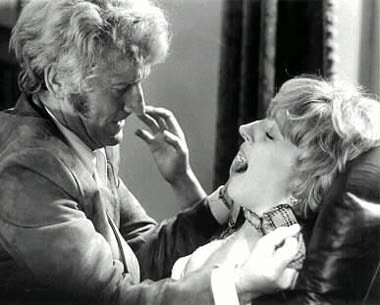
The story is a Hitchcock staple: a troubled guy is falsely accused of murdering a woman, and he must work against authority figures in order to prove his innocence. But without the need to work against censors, which often forces a filmmaker to resort to more creative means, Hitchcock was free to depict his rather disturbing fascination with strangulation in a more graphic manner. The potential downside to this new-found freedom is that a filmmaker can go too far, and push the envelope when modesty may work best. What's remarkable about “Frenzy” is that Hitchcock, with the exception of a grating sequence involving a detective's wife bringing out disturbing-looking plates of food for dinner, knows when and when not to employ these new, more explicit filmmaking tools for the greatest effect.

“Frenzy” is not one of the director's best works: his characters aren't all that memorable, and he has explored this kind of story before – the film has a rather tired feel. (Admittedly, I may feel this way because the film was shot in the 1970s, when people and clothes were really ugly, and with an intentionally desaturated look, but I digress.) What Hitchcock offers us is a decent film with a few brilliant flourishes. Such moments as the notoriously brutal and unflinching murder sequence, where a “nice” guy gives in to his more violent impulses, and rapes and strangles a nice marriage counselor with his necktie, serve as a reminder that Hitch, even in his old age and his poor health, was a one-of-a kind filmmaker. I can't think of any other director who could assault his viewers with a horrible rape sequence, and have them love him all the more because of it.


“25th Hour” (2002), which stars Edward Norton as a former drug dealer, named Monty, who is about to go to prison, is only the third Spike Lee movie that I've seen – I now regret having seen so little of his work. It's a long and challenging film, but it's efficiently edited, well shot by the cinematographer Rodrigo Prieto, and so unusually compelling that it generally avoids its own potential pitfalls. “25th Hour” was filmed in New York during the aftermath of the Sept. 11 attacks, and Lee parallels the destruction, and reconstruction, of Ground Zero with the downfall and reconstruction of Norton's troubled character.

Lee is a bold filmmaker. He risks de-railing his narrative with a ten-minute rant, in which Monty, venting his director's frustrations - “Send those Enron assholes to jail for fucking life!” - gives an exasperated “fuck you” to just about every aspect of and person in New York. It's an unusual and self-reflexive sequence, but I think it's all the more stunning for those very reasons. I could imagine some viewers hating the sequence, particularly because it feels so arbitrary. But it really isn't - “25th Hour” is as much a testament to how Lee loves and hates his city as it is for Monty.

“Frenzy” First Viewed: 12/10/08, on DVD - IMDb
“25th Hour” First Viewed: 12/9/08, on DVD - IMDb

Note: I forgot that "25th Hour" is actually based off of a novel. Monty's rant is taken verbatim from the book. Nonetheless, I feel that Spike Lee could relate to the issues that the rant addresses, which is why it feels so powerful and personal, in my opinion.

Wednesday, December 3, 2008

The Birds

"The Birds"
Alfred Hitchcock, 1963


Note: I'm taking a course on Hitchcock, and every Wednesday we have a screening of one of his films. Then we write our thoughts in a "journal," which we turn in the next day. This is one such journal. There are spoilers.

I first saw The Birds (1963) over ten years ago, on a VHS tape and a small screen. Even at that age I was blown away by the sheer spectacle of it all. But what I remembered most clearly from that initial viewing was the haunting image of the dead farmer, his eyes gouged out and his body riddled with bite marks. It struck an even more powerful chord with me this time around. I think that it is such a powerful scene because it deals with the notion that normal things that we take for granted can turn against us; at first, the birds are harmless, but for absolutely “no reason,” they suddenly turn into flesh-eating monsters.

The way that Hitchcock constructs the scene is brilliant. It begins with a long take of the mother slowly walking down the hallway, followed by brief point-of-view shots of the room – in total disarray and covered with streaks of blood – finally culminating in a trio of shots that jumps closer and closer into the corpse's mutilated face. In that brief moment, the mother's shock and terror becomes our own. It bears some similarity to the tracking shot on Charlie's hand in Shadow of a Doubt, when both Uncle Charlie and we realize the importance of the ring on her finger.

To be honest, I think that the setup of The Birds is weak; the connection between Mitch and Lydia is sketchy at best. But the film is really about tension, and in that regard it is a masterpiece. First, there is the actual tension that develops within the utterly bizarre love, um, quadrilateral between Mitch, Lydia, the mother, and Annie. We don't really understand what happened in these characters' pasts, but given the amount of animosity between the characters – most of which is unspoken; it is instead depicted through a number of glares, and the way that Hitchcock positions his characters within the frame – would we really want to find out?

Second, the actual bird attacks are masterfully conceived and executed. Every time a character was attacked, be it a child or a random stranger, I was shocked. I'm not really sure why those attacks were so powerful – I'm surprised that some viewers in the class laughed at many of these moments – but I can posit a guess. In the sequences within the house, we get the sense that our protagonists, led by Mitch, who is an ostensibly strong figure, are completely powerless. I think that Robin Wood sums it up perfectly when he describes the sequence as such: “The home-as-refuge becomes home-as-cage.” The Birds is so unsettling because of this very inversion of everyday life. Our protagonists are powerless, their home turns into a prison, and their fates are left up in the air.

Rating: 9

Second Viewing: 12/3/08, on DVD - IMDb

Tuesday, November 25, 2008

Were the World Mine

"Were the World Mine"
Tom Gustafson, 2008


The hero of “Were the World Mine,” a new film that is based off of Shakespeare's “A Midsummer Night's Dream,” is a gay teenager named Timothy (Tanner Cohen), who attends a private, all-boys high school. Timothy has already come out to his mother, who, as a single parent struggling to find work, views his sexuality as yet another burden that she must carry. In P.E., he's often teased, and occasionally beat, by other students, with the encouragement of their pugnacious and homophobic coach (Christian Stolte). Timothy escapes from his travails by fantasizing about the hot guys in his class singing to him, shirtless, and in near-perfect synchronization, as if performing in a play.

Coincidentally, Timothy has a class with an affable English teacher named Ms. Tebbit (Wendy Robie) who encourages him to audition for the school's rendition of “A Midsummer Night's Dream.” Timothy, as it turns out, is a natural actor with a lovely voice. He's an untapped talent, and is given the leading role as the fairy (har har), but he has another unusual gift – he can make the love potion in Shakespeare's play work in real life. He gives nearly everyone in the town a whiff of the potion, which makes the person – or victim? - fall madly in love with the first person they lay eyes on.

Timothy, by way of his drug, receives the affections of the really cute captain of the rugby team, while the rest of the town's “moral” centered-ness disintegrates. It's surprising that given the setup, the profusion of hot guys, and the above-average visuals, “Were the World Mine” is so dull. Every gay person can relate to Timothy's crush on the high school jock, and how such people turn out to be incredibly hetero-normative. It's a fantasy that I thought I'd like to see play out on screen, but the film is really dealing with obsessions, not with love as it so claims.

A straight friend accidentally receives a dose of the love potion, and promptly grows enamored of Timothy; he's willing to fight to the death with the rugby team's captain for Timothy's favor. “Were the World Mine” feels deceiving because it puts such unreasonable obsessions on the same level as Timothy's real life crushes. This is not so much a film about a gay teen's fantasy, though this is what the film is really trying to be about, as it is a semi-cautionary tale about how unhealthy it is to obsess about other people. I would be content with an exploration of either aspect, but given the rather sloppy way in which the film is conceived, neither part plays out to a satisfactory extent.

At the end, after Timothy has “had his fun,” he casts a spell on everyone in town, returning them to their normal, pre-obsessive states. But everyone has, to some degree, had their eyes opened about love, acceptance – or something. It's not entirely clear what the lesson is, but it isn't all that important anyway. What matters most is the revelation that the rugby captain has really been in love with Timothy all along, and that it took the spell, the lifting of social misgivings about homosexuality, for him to finally accept that. So, our hero becomes a part of the gay fantasy incarnate. But it remains nothing more than a fantasy. Like waking from a dream, the contrivance of it all makes us feel not joy at Timothy's victory, but disappointment at its very flimsiness.

Rating: 5


First Viewed: 11/25/08, in 35 mm projection - IMDb

Saturday, November 22, 2008

Beautiful Thing

"Beautiful Thing"
Hettie Macdonald, 1996


"Beautiful Thing"
is the film adaptation of an English play about two teenage boys who fall in love with each another. It's a cute story, but it does nothing for me. It is the type of movie that doesn't strive to surprise or enlighten us. It makes us feel good that things work out, which is exactly what what we expected from the start. Most of the scenarios suffer from an intangible, musty feel, as though the filmmakers demand that we feel for these characters, even though they are obviously nothing more than flat and largely unconvincing actors spouting out requisite lines about angst and love. On the upside, the relationship takes place in a very average setting - low income housing - between two very average-looking and socially awkward guys. I suppose there is something comforting and uplifting to be found in that, for us normal, and still single, viewers at least.

Rating: 3.5

First Viewed: 11/22/08, on DVD - IMDb

Tuesday, November 18, 2008

Snow Angels

“Snow Angels”
David Gordon Green, 2007


In our introduction to the unnamed town in which David Gordon Green's film “Snow Angels” is set, we witness an off-key high school band practicing on the football field. It is the middle of winter, and we can see the students' breaths as they maneuver through the freezing air. There is a certain resignation in their labored movements and in their inability to please their increasingly frustrated band leader, who is considerably older than his students. Here, Green establishes an interesting rift between a frustrated younger generation and an older one that is even more resigned to its small-town fate; it feels like members of both generations have been sapped of creative and emotional energy by the literal freeze that envelops their town.

Green, working with the cinematographer Tim Orr, carefully constructs the film's atmosphere by washing his characters in bright white light and keeping them confined within the frame, either in close up or long shot; the town somehow feels empty and claustrophobic at once. Within such a high-pressure setting, Green is intent on exploring the notion of the family ideal, and specifically with how that ideal is always sought after – if not expected – and never reached, with disastrous consequences.

At the center of Green's film is the very sad narrative concerning Annie (Kate Beckinsale) and Glenn Marchand (Sam Rockwell). Theirs is a marriage that has gone to the dogs, due to Glenn's drinking problem. During the day, Annie works at a crappy Chinese restaurant, takes care of their daughter and, at night, has sex with a co-worker's husband at a cheap motel. Glenn, who now lives with his apathetic parents, is in recovery. He has turned to God, and he's trying his best to find a job and to win back Annie's trust. But that proves to be an idealistic goal, because Annie, with good reason, refuses to let him take care of their daughter. Glenn, in his deep sorrow, his desperation, and his disillusionment with a society that is supposed to provide people a second chance, once again turns to drinking, and his behavior turns increasingly erratic. His story is a tragedy, and Rockwell's performance is a devastating portrait of all the things that can go wrong in a marriage converging upon an individual.


Green provides a counter-narrative of sorts in the relationship between a high school band member named Arthur (Michael Angarano), whose parents, while highly successful career-wise, also have a rocky marriage, and a girl who has just moved into town named Lila (Olivia Thirlby). It's a refreshing story, and both actors nail the sweet, almost bashful nature of their burgeoning attraction for one another. Within “Snow Angels,” though, it feels like an alternative reality, the ideal relationship that, in Green's mind, exists without the prospect of all-too-early marriage between two immature individuals. It is not surprising, then, that the Glenn-Annie narrative doesn't always mix well with the Arthur-Lila narrative. As Glenn heads into even more despair, resorting to desperate measures that feel weak, and scripted, precisely because of their very theatricality, Arthur and Lila have sex for the first time. It's a baffling juxtaposition, but with these two competing narratives, we have the sense that there is a reinvigoration, a thawing, with each successive generation, but that the ones who are left behind resort to self-destructive behavior. Perhaps that is their only recourse, and, perhaps, this is best for the town in general, so that those looking ahead for a better future can continue their endeavor unabated.

Rating: 8.5


First Viewed: 11/17/08, on DVD - IMDb

Saturday, November 15, 2008

Quantum of Solace

“Quantum of Solace”
Marc Forster, 2008


James Bond, in his numerous iterations, has emerged as something more than a character: he is an icon. What this icon represents has changed from film to film, but it generally relies upon several things – the agent's charm, his gadgets, his unprecedented capacity to seduce women, and his ability to enter and leave a film relatively unscathed, in time for the inevitable sequel. On a few occasions, the creators of Bond films have tried to step out of the constraints imposed by such a timeless icon by killing off a character that he truly cares for, with the hopes that the audience will perceive Bond more as a character than an icon, a human rather than a joke (Roger Moore in “Live and Let Die”) or a ruthless machine (Timothy Dalton in “License to Kill”). “On Her Majesty's Secret Service” and, more recently, “Casino Royale,” are such films, and because of their focus on the emotional aspects of the character, they serve as excellent, distinctive chapters in the franchise.

“Quantum of Solace” begins where its predecessor, “Casino Royale,” left off. James Bond, who is played by Daniel Craig, is seeking revenge for the death of his girlfriend, Vesper, who was played by Eva Green. In the process, Bond discovers that there is an international criminal organization called QUANTUM that is largely responsible for much of the world's instability and, perhaps, for Vesper's death.

Craig plays Bond as a resolute and, on rare occasion, sexy psychopath. It is a convincing performance, but the problems with “Quantum of Solace” arise not from Daniel Craig, but from the way in which the film was conceived. The director Mark Forster wants to address the many potentially fascinating aspects concerning Bond, but, while juggling the surfeit of activity, he crafts a disappointing film that is average in nearly every way. First and foremost, Forster wants to make his film a spectacle, but his action sequences are uninspired and poorly executed, entailing an assault of quick edits reminiscent of “The Bourne Ultimatum” (the technique isn't nearly as effective in this case) and poorly implemented C.G.I.

And then there is the nature of Bond himself. Forster attempts, in a rather perfunctory manner, to tackle the contradictions that are at the center of this man. As “Casino Royale” illustrated, Bond was trained as a killer, but he is ultimately a human, fallible to such things as falling in love. In “Quantum of Solace,” Bond is a ruthless killing machine who defies M's (Judi Dench) orders and, while deftly absorbing numerous kicks and punches, kills numerous suspects. Perhaps Bond is reacting, violently, to his own weakness, suppressing his emotions because, when he allowed them to shine through, he was hurt in an unprecedented way, much more so than the physical assaults he regularly endures. But this is my own observation about the matter, taken almost entirely from my viewing of “Casino Royale.”

Forster's film isn't nuanced enough to deal with these implications seriously. One of the film's biggest failings is its insistence on spoon-feeding this concept through its almost sadistic fascination with violence. Violence can be used to powerful effect in films, but in "Quantum of Solace," it is used as an assault on its viewers. We constantly witness Bond beating up various enemies: some are thrown off of roofs, others are stabbed with glass shards, and a number are knocked out cold in an elevator. What we witness - or at least try to, thanks to the shoddy way Forster has shot and edited his film - is an invincible machine doing what he does best. Anthony Lane, in his excellent review, mentions that there is also a masochistic thread running throughout the film; Bond wants to murder people so that he can hide his own troubles, and render himself, to some degree, numbed. But there is no rhyme or rhythm to the violence committed by our machine of a protagonist, and after only a few minutes, we simply don't care what he does or what happens to him.

Everything in the film, the action sequences, the exploration of our complex protagonist and the silly, threadbare plot, feels obligatory, but uninspired. The film is approached with an attitude that, much like its protagonist, borders on the indifferent; the result is neither exciting nor compelling. Once again, the complex humanity, the character, behind Bonds' cold exterior has given way to broad strokes, this time veering towards the portrait of Bond as a machine. Admittedly, Craig's rocklike visage emphasizes the exterior rather than the interior, but, as we've seen with “Casino Royale,” the character can and has been successfully tapped into. This time around, James Bond, the icon, has persevered.

Rating: 5

First Viewed: 11/14/08, in 35 mm projection - IMDb

Saturday, November 8, 2008

Caché

“Caché”
Michael Haneke, 2005


In “Caché,” a TV host named Georges (Daniel Auteuil) and his wife, Anne Laurent (Juliette Binoche), receive a bizarre tape, which depicts their house being photographed from an unknown location. The anonymous creator of said tape has wrapped it within a drawing of a child vomiting blood. It's extremely unsettling, but when the couple go to the police for help, they are told that they are on their own – unless they are actually attacked, of course. From there, we watch Georges and Anne as they try to go about their lives in a normal manner, even while outside forces are striving to disrupt such routines.

The title, “Caché,” translates to “hidden,” which is a theme that trickles down through the entire film. The director Michael Haneke constructs his film around a series of interactions between his characters, all of which are played out in their entirety. It is an engaging method that both belies and accentuates this central motif, because while watching these characters, we get the sense that there is much more to them than meets the eye, and that merely witnessing their interactions doesn't quite do them justice. Georges, for instance, is trying to hide the fact that the anonymous person who sent the tapes is probably the son of a servant during his childhood, who is angry at him for unstated reasons. Yet he lies to Anne about what he really knows. Why does he do this? Georges tells her that he doesn't want to hurt her; he is really saying that he doesn't want to resurrect memories that will hurt him.

“Caché” is fascinating because of its very ambiguity, because of this tension that arises when we are, at least ostensibly, made witnesses to everything that occurs, yet are forced to extrapolate what exactly is going on. But such an approach has the unfortunate effect of making it difficult to consistently connect, on an emotional level, with the characters. This is particularly apparent in the narrative concerning Georges and the anonymous person. That narrative culminates in an utterly random explosion of violence that elicited – at least from this viewer – a chuckle, rather than a gasp of horror. Perhaps this is what Haneke was trying to go for: we can't really react well to such a situation, because the connection between Georges and other characters always will be, for us, the uninitiated viewer, poorly developed. What Haneke ultimately appears to be telling us is that we can't truly know anyone, much less a couple of protagonists in a two-hour film.

Rating: 8


First Viewed: 11/7/08, on DVD - IMDb

An Update

Hello! I haven't written many film reviews recently because I've been occupied with school, following the election, and watching films for my Hitchcock class. In general, I write a lot of reviews when I'm on break - this summer, I was usually writing at least five reviews a week! By the end of this weekend, however, I hope to post a review of the film “Caché” as well as my thoughts on the passage of Proposition 8.

I have changed the look and layout of my blog because I was getting kind of tired of all the blue. But I'm open to any feedback regarding the changes.

Last night, I took part in a huge march in San Francisco, in protest of the passage of Proposition 8. There were at least several thousand protesters, and we marched from Market Street all the way to the Castro District. The march was an awesome, peaceful show of solidarity; the culmination at Dolores Park was a bit disappointing, though - it was, like, a transsexual speaker with a DJ playing music, encouraging people to dance. That was rather lame.

Here are some pictures that I took, just to show how huge it was.


Friday, October 31, 2008

A Long-Winded Rejection of Anti-Gay Arguments

A Long-Winded Rejection of Anti-Gay Arguments


Last week, I ran into a former dorm-mate of mine, who is a rather eccentric social conservative. Fixed to the rear of his backpack was the requisite McCain-Palin sticker, and below that a large “Yes on 8” sticker. The latter refers to Proposition 8, which is a California initiative that “Eliminates [the] right of same-sex couples to marry.” This man, who I'll call Paul, is the first person I've actually run into who supports Prop 8, and being gay myself, I decided to ask why he was voting “yes” on the measure.

Paul explained that homosexuality was a sin according to the Bible, that it was natural for a man and a woman to be in a family, that throughout history societies that featured “open” homosexuality subsequently collapsed, that it would allow other forms of sexual deviance to be widely accepted, and that being gay was a choice. The more I listened to Paul's arguments, the more I realized that we viewed Prop 8 in completely different ways. For him, this is an issue about maintaining societal normality and morality; for me, it is a pivotal civil rights issue.

When I asked him how he could substantiate his arguments, Paul invariably fell back on several justifications, including the Bible, a nebulous reference to “history,” and an even more nebulous reference to some “studies.” Let's be clear: these are not valid ways to support an argument. There's really no rational way to support or refute these reasons, since the guy views this as a moral issue, but I'll try. As I see it, the Christian testament's central message is that we should love one another. Jesus – who I, being Jewish, view as an important leader and, perhaps, a prophet, but not the Messiah – never mentioned anything negative about homosexuality, and he embraced lower-status people to the shock and consternation of his followers. When I offered this rebuttal to Paul, he had no response, other than the fact that homosexuality was declared a sin in the Hebrew testament.

Now, when it comes to the issue of what defines a “traditional” marriage, things get a bit tricky. Paul is correct when he says that most families throughout history have involved a man and a woman; but he provides no reasons as to why this has occurred. I can speculate that it has to do with the capacity for the heterosexual couple to reproduce, and that societies and the Church have then shaped cultures so that reproduction is seen as the ultimate goal of marriage. (If nothing else, such child-bearing couples helped to increase the number of members of a religious sect. Again, this is all speculation.) Paul did not recognize, however, that there have been gay people all throughout history, and while gay couples may not have been married, they did, in fact, exist. And his argument that civil unions provide gay couples with the same rights as married couples is, in effect, a resurrection of the “separate but equal” argument of Plessy v. Ferguson. Civil unions are ineffective as a long-term solution because they fail to address the underlying issue: a group of people is being treated separately based off of one set of criteria, which is inherently unequal.

The main thrust of Paul's argument regarding traditional marriage concerns how children without the proper balance of a man and a woman grow up in a deprived environment that results in them, essentially, being fucked up. Paul mistook my silence as a recognition that his argument is correct. To the contrary, who says that a child in such an environment ends up being deprived? Studies do. What studies? Well, studies. And history, of course. Again, Paul presented his views in an ostensibly rational manner, but ultimately without any way to fully substantiate them. Here is my counter-argument. Look at heterosexual couples and see how many fucked up people result from such families. And as for the notion that gay couples raise children who are more likely to be gay, I offer this question: to whom was I born? A straight couple. In fact, all gay people come from heterosexual relationships. The only practical advantage to a heterosexual couple over a homosexual one is that the former can reproduce, which is certainly important for the survival of our species. Some supporters of Prop 8 argue that gays can't reproduce, so they shouldn't be allowed to marry. But if that is the case, then heterosexual couples that can't or don't want to have children shouldn't be allowed to marry, either.

~ ~

It all comes down to how we view marriage. Is it a union that recognizes two people who love one another, or is it also a way in which we can help our population grow? I can't really answer that question, because it's up to each of us to decide our own priorities. So, let me now turn to the most touchy argument that Paul brought up: that opening up marriage will lead to the legal and social acceptance of “other” forms of sexual deviance, such as incest. Here's my position on the matter. I don't necessarily have an issue with an incestuous couple being married, because I believe that the State should not interfere in people's lives and narrowly define an institution like marriage. However, I suspect that most people involved in incest have big psychological issues, and I question whether such a couple's commitment to one another would be consensual or a true expression of love. Gay couples, on the other hand, consist of two people who are in love with one another, and who truly want to be together. The argument that “other” forms of sexual deviance are even on the same playing field as gay relationships is absurd.

And finally, there is the issue of whether others view being gay as a matter of choice. When I asked Paul whether he thought my being gay was a choice, he replied, “Yes, I do.” I have never understood this argument. One, because there have always been gay people, even in times of persecution. Two, because I can't "help it" that I'm attracted to guys. Paul would never be able to appreciate this, but as a teenager, I struggled for over five years trying to be attracted to girls. Three – and this is what I told Paul – why would I want to be gay when there are homophobes in the world, and when society generally paints homosexual relationships as inferior to heterosexual ones? His reply: “That is indeed the question.”

~ ~

For such an unusually succinct measure, Prop 8 carries a great deal of importance for a lot of people. The Family Research Council President Tony Perkins stated that Prop 8 is “more important than the presidential election.” The Church of Jesus Christ of Latter-day Saints has contributed an astounding $20 million to the Protect Marriage campaign. Meanwhile, opponents of the measure have been fighting back. Apple and Google contributed over $150,000 to the No on 8 campaign. In the meantime, my friend, Hillary, organized an art show – to which I donated some of my photographs – that raised $1,300 in a single night. For the last month, my friend, Jon, has been fervently phone-banking undecided voters, many of whom live in my home town, San Diego.

For some, Prop 8 is a measure that will eliminate an imminent threat to the “sanctity” of marriage. Indeed, gay marriage is a shift from traditional notions of heterosexual relationships. Personally, I would have preferred if gays were legally and socially accepted in a more gradual manner, first with the passage of hate-crime legislation, and then with the passage of laws that prevent employment discrimination based off of real or perceived sexual orientation. Regardless, gay marriage is here, and despite the polarizing effect of the California Supreme Court's ruling, it has finally brought a long-hidden issue into the public sphere.

As I've already pointed out, homosexuality has been with us from the beginning. For too long, people have ignored the detrimental effects of forcing gay people to recognize that a heterosexual relationship is the ideal and exclusive way to love another person. And though the process has been painfully slow, people are beginning to accept homosexuality as a normal, non-threatening occurrence. Voting “no” on Prop 8 would prevent the passage of a discriminatory measure, protect my rights, and the rights of millions of others, as well as facilitate the acceptance of gays, who, as normal people, deserve to have the rights that many other Californians take for granted.

~Max~
October 31, 2008

Saturday, October 18, 2008

Alphaville

“Alphaville”
Jean-Luc Godard, 1965


One of my acquaintances described the work of the French New Wave director, Jean-Luc Godard, as such: “His [Godard's] movies are at once serious and intellectual, as well as trashy and playful. . . . Imagine The Naked Gun directed and written by a philosopher, and you have an idea of how he's like.” This is a perfect description of “Alphaville,” which is the first Godard film that I have seen. Ostensibly, it is a mixture of science-fiction and film noir, and we follow a haggard private eye as he journeys through the futuristic town of Alphaville, which is run by a menacing super-computer.

There are many potentially fascinating themes at play here. What, for instance, is the role of women in this society? All of them are gorgeous, but they behave like robots who are enslaved to men. There is one major narrative that centers on the private eye and his love for one of these women, and his attempts to save her from the clutches of the super-computer, which seeks to turn all people into mindless drones.

Admittedly, the plot doesn't make much sense. The lengthy monologues by the super-computer, too, don't make sense. “Alphaville” is really the product of a director who simply loves to make films. Godard has a wonderful, off-kilter sense of humor, and he loves to arbitrarily experiment with his camerawork, sound, and acting. This results in a surprisingly approachable and fun film that belies its narrative's pessimistic vision of a de-humanizing future. In short, “Alphaville” is rather awesome.

First Viewed: 10/17/08, in 35 mm projection - IMDb

Wednesday, October 15, 2008

The 2008 Presidential Debates, Round Three

The 2008 Presidential Debates, Round Three
Hofstra University, New York, 15 October 2008

Upon reaching the end of this third, and final, debate between the Democratic candidate Barack Obama and the Republican candidate John McCain, the decision, for those voters who are still undecided, has become all the more clear. One candidate calmly explained the nuances of his positions, held a comfortable and respectful posture, and, ultimately, maintained a presidential manner. The other stooped to a new low in his efforts to continue telling lies, in his condescending and even hostile manner towards his opponent, and in his tired and out-of-touch rhetoric. The former, of course, was Barack Obama, and the latter was John McCain.

This was an especially disappointing evening for McCain, who actually started off on a relatively strong note compared to his previous debate performances. Where McCain really began to lose ground was in his reiteration of the cynical attacks that have come to define his campaign in recent days: tying Obama to ACORN, making a dubious connection between Obama and Avery, and how he was personally offended by John Lewis' criticisms of his campaign tactics. These tactics have not been working for McCain, and he did not appear comfortable delivering such trivial criticisms.

McCain, unfortunately, made many more mistakes. He invoked a middle-class voter that Obama had met on the campaign trail, whom he referred to as “Joe the Plumber”; this is a childish moniker that ultimately demeans voters - to whom was he trying to appeal? - and it should never have been brought up in the first place, let alone repeated over a dozen times. He continued to repeat out-of-date rhetoric, including the danger of high taxes and the nebulous threat of big government imposing itself on people's everyday lives. Note that he never mentioned the middle class, who would never benefit from his proposed tax cuts.

McCain also argued – or, more likely, bull-shitted – that his running mate, Sarah Palin, was a role model for both women and reformers. More irksome was his emphasis on “curing” autism – since when did this become an enormous national issue? – which he says Palin's child suffered from, when, in fact, the child has Down's Syndrome. To top it off, McCain came across as an angry, condescending old man who is bitterly jealous of Obama. Such quotes as “But maybe you [Obama] ought to travel down there [Colombia] and visit them and maybe you could understand it a lot better” don't help with dispelling this unfortunate image of this once respectable candidate.

Obama, in the meantime, maintained a supremely calm presence. For the most part, he threw effective counter-points, and he disarmed blatant lies with a smile. One line, regarding the McCain campaign's negative tactics, was particularly effective: “The fact that this has become such an important part of your campaign, Senator McCain, says more about your campaign than it says about me.” And Obama kept connecting McCain to the Bush administration, which is exactly what he needed to do to help convince undecided voters.

I do think that both candidates have weak education plans, because neither of them are comprehensive or innovative. But when it comes to vision, manners, the ability to work with opposition members, maintaining a commanding presence, and running an administration, I think that the choice is obvious – Barack Obama should be elected President of the United States on November 4th.