Thursday, July 31, 2008

Paprika

"Paprika"
Satoshi Kon, 2007

In "Paprika," an engrossing science fiction tale that uses a combination of computer-generated effects and hand-drawn animation, a team of researchers, led by a steely woman named Atsuko, creates a device that allows them to enter people's dreams. The potential for effective therapy notwithstanding, these researchers don't have any idea about the dangers of this new technology, which become all too apparent when they, while hooked up to the device, become trapped within their own dreams.

Atsuko, who works under the guise of "Paprika," a charismatic, red-haired superhero, while she is in the dreamworld, is confident that she can save the team, and her product. But naturally, complications arise. "Paprika," with its vivid colors and often disturbing visuals, works beautifully as an exploration of whether it is healthier to let our lives be ruled by reality or by our more fantastical dreams. One of the characters, Detective Kogawa, abandoned his true passion, making movies - a common motif, and an interesting one given the film's focus on reality vs. illusion - and he uses the dream machine for constructive purposes, to figure out how he can incorporate his lifelong aspirations into his everyday life. One of the researcher's assistants, Himuro, on the other hand, uses the device for more destructive purposes. Having a banal career, he wants to remain within the illusion created by the confines of his own dreams, at the expense of his physical well-being.

As Himuro and other researchers become trapped within their own dreams, the dreamworld begins to have a will of its own, and many people's dreams meld into one consolidated nightmare that extends into the real world. This dream has a veneer of happiness, as the trapped researchers march with a rambunctious, confetti-strewn parade of toys; but underneath is a sinister side, the darkness of people's sub-conscious, I suppose, which is purely surreal and brilliantly realized. Atsuko, unwilling to delve into her own culpability, suspects that there is someone behind this, and indeed, in the film's climax, we discover that the researchers' chairman, a cadaverous man trapped in a wheelchair, is the villain. "Paprika" does suffer from making a villain responsible for the mess, and it doesn't help that his reasons for taking over the dreamworld are disappointingly conventional. Dreams, we discover during this experience, are much more compelling and much more terrifying when there's no rhyme or reason to them.

First Viewed: 7/31/08, on Blu-ray Disc
IMDB Page

Making It: How Chicago shaped Obama

"Making It: How Chicago shaped Obama"
The New Yorker, July 21, 2008
By Ryan Lizza

Well, I finally finished reading this 16-page, 17,000-word article on Barack Obama's political career in Chicago from the early 1990s through 2004. It's strange, because in sticking with this article over the past two weeks, it feels like I have been performing a civic duty; I felt a need to better understand the candidate, even though I was often on the verge of giving up on reading about him altogether.

It's not that the article is boring or poorly-written. This is a showcase of exemplary writing, and The New Yorker's never-before-seen - at least by me - photographs of Obama provide wonderful snippets of his career. There are simply so many insights provided by so many people that it grows overwhelming. It would have been nice if Lizza had, in the manner of Russian novels, provided a list of all the people he interviewed and their relation to Obama, because I forgot who they were almost immediately after he initially wrote about them.

Despite the enormous breadth and length of "Making It," I still find it to be a fascinating and logically-constructed article on who Obama really is. We read about a politician, not a Messiah-figure, who is so adept at maintaining networks, organizing campaigns, and using the current institutions in his favor that his bid for the presidency seems inevitable. I like how Lizza gives equal care to those who used to be close to Obama and now criticize him; he has shifted his friendships over the years, leaving a number of people feeling disillusioned. But this is all inevitable in the life of a politician, and it is fascinating to read about how Obama quickly learned from his many mistakes to transform himself into a better politician - he switched from the stiff speaking style of an "arrogant academic" to that of a more laid-back, charismatic leader, for instance.

"Making It" is a long and challenging read, but it is certainly a worthy time investment.

Rating: 9

A Link to the Article, on The New Yorker's Website

Wednesday, July 30, 2008

Peeping Tom

"Peeping Tom"
Michael Powell, 1960

"Peeping Tom" is a film about, well, a voyeur, who is named Mark (Karlheinz Bohm). Mark is a handsome introvert, and an outsider who cannot comfortably interact with anyone. So, when he isn't working in the movie studio as a focus puller, he simply walks around and observes, shooting footage of everything he witnesses with a small 16 mm camera. But Mark is no ordinary voyeur. He has an unfortunate habit of murdering women, with the pointed end of his camera's tripod leg, no less, and attains a perverse pleasure from viewing their terrified faces before they die.

When Mark befriends a fellow tenant named Helen, however, he begins to open up and, at her behest, show her some of his films. Whether or not the well-meaning, if slightly naive, Helen is ready to accept his dark secrets is an entirely different matter. This film bares some comparison to Hitchcock's thriller, "Psycho," which was released only two months later. Shot with Eastman color stock, "Peeping Tom" features unusually rich visuals, and Michael Powell's use of lighting, with its deep shadows and beautiful array of colors, is impeccable. "Psycho," which was shot on black-and-white stock, has visuals that are equally striking, but its monochromatic visuals create a bleak atmosphere that hints at the way the film's psychopath, Norman Bates, views his world; everything is either dead-or-alive, black-or-white, with no room for discrepancy.

Both films center around very creepy individuals, but "Psycho" is more successful as a work of suspense; Bates, because of Anthony Perkins's performance and Hitchcock's bleak atmosphere, is a terrifying and volatile presence. Mark simply isn't as compelling or frightening a figure, in comparison. And then there are the weak aspects of "Peeping Tom," some questionable acting by the extras, a few awkwardly staged dialogue exchanges, and a tedious narrative concerning the police's investigation of the murders. I still find "Peeping Tom" to be a good companion piece to "Psycho," but then again, I, like Helen, have always been a sucker for pretty photography.

Rating: 7.5

First Viewed: 7/30/08, on DVD
IMDB Page

Tuesday, July 29, 2008

L.A. Story

"L.A. Story"
Mick Jackson, 1991

Harris Telemacher, who is played by Steve Martin, is a local news station's weatherman, a titular position since L.A. is always sunny and seventy-two degrees - with the occasional threat of freezing fifty-eight degree weather, of course. "L.A. Story" starts off as a promising, funny critique of L.A.'s purely superficial culture. One particularly memorable sequence, "The Spring Equinox," depicts Telemacher, driving with his material-oriented girlfriend, defending himself from other vicious drivers on a freeway by pulling out a pistol and engaging in intense gunfights.

Even for a film that fully embraces its obvious critique of L.A., throwing jokes at every possible turn, it's surprising how quickly "L.A. Story" loses steam. After the first fifteen minutes, Steve Martin, who is the writer, seem to run out of ideas and his film suddenly becomes a predictable love story, where Telemacher falls in love with an awkward British woman who is anything but superficial. There are moments of touching comedic brilliance, especially those in which a lonely freeway sign sends cryptic messages to Telemacher, but in straying from its more inspired beginnings, "L.A. Story" ends up being an experience that isn't all that memorable.

Rating: 6

First Viewed: 7/3/08, on DVD
IMDB Page

Sunday, July 27, 2008

Tell No One

"Tell No One"
Guillaume Canet, 2006

This film is a puzzle. Its plot, centering around a doctor who tries to figure out why his wife was murdered eight years prior, is intricately laid out. The film's pacing is both patient and efficient, and the director, Guillaume Canet, refrains from giving us any easy answers. His camera focuses on the little moments in order to slowly excavate his characters - there is a very brief shot of a waitress' bottom, followed by a reaction shot of one of our protagonist's friends staring at it, for example.

Unlike most puzzles, though, this unusually compelling thriller is a lot of fun to piece together. The actor, Francois Cluzet, working with all the tools that Canet gives him, delivers a wonderful performance of an ordinary man who is thrust into appalling situations. His character, Dr. Beck, tries to put the murder of his wife behind him, but something keeps holding him back. Every year, on the anniversary of her death, he visits his parents-in-law, which is always an awkward event. But the eighth anniversary is different; two bodies, presumably of the people who murdered his wife, are discovered nearby. The police reopen the case, and Dr. Beck, once again, becomes their prime suspect.

All of Dr. Beck's frustrations build until finally, when the police decide to arrest him, he simply runs away on foot. In most films, such chase sequences are clumsily-constructed, and they ultimately fail because they are, in the end, excuses for loud, action setpieces. This sequence is certainly an action-oriented setpiece, but it is anything but clumsy in its execution. Canet's edits are clean, and his use of sound is spare and devastating; all the while, his camera doggedly tracks our protagonist's every step. Never before have I empathized with a character, trying to flee both from his pursuers and from the ghosts of his own past, so much in the midst of a chase.

Unfortunately, the film takes the relatively easy way out during its ending. One of the characters reveals almost everything to Dr. Beck; it is all some sort of conspiracy involving political figures we hardly meet during our adventure. For a film that meticulously constructed everything up to this moment, layering clue upon clue perfectly, it is disappointing that Canet felt a need to jam everything together awkwardly, right at the crucial moment of our character's ultimate discovery. Nonetheless, "Tell No One" is an enthralling, beautifully-crafted film in which we ourselves become participants and, alongside our characters, attempt to piece together the mystery.

Rating: 8
.5

First Viewed: 7/27/08, in 35 mm projection
IMDB Page

Saturday, July 26, 2008

Chris & Don. A Love Story

"Chris & Don. A Love Story"
Tina Mascara and Guido Santi, 2008

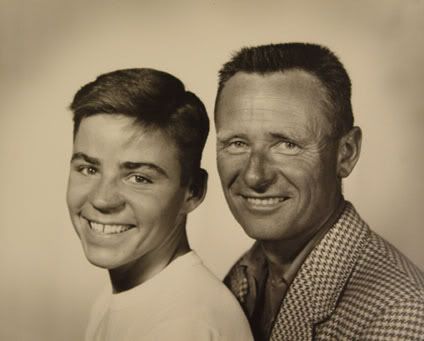
I admire people who have the courage to go against the grain and engage in what they love, even if all of society is working against them. Thus, my interest in this new documentary, which follows the decades-long romance between a 19-year-old future portrait artist and a 49-year-old writer, Don Bachardy and Chris Isherwood, respectively, that began in the 1950s. This is a touching story about two men who remained dedicated to each other in spite of their huge age gap and other relationship issues that cropped up.

The filmmakers mix in fascinating archive footage, shot by Don and Chris themselves, simple animation involving a cat and a horse, which serves as a representation of their relationship, and several hazy and pointless re-enactments. Don himself, who is seventy-four years old, sports very stylish glasses and still paints portraits, serves as the unofficial narrator. Despite growing up in L.A., he speaks in an unusually eloquent manner, and with a hint of a British accent, both of which he attained from the British-born Chris.

Don isn't afraid to delve into the darker aspects of his relationship, especially with regards as to whether it was in his best interest to engage in such a dedicated relationship when he was so young. After all, he had little time to develop himself as an a unique individual, which frustrated him and even led to some extra-relationship affairs. Chris died nearly twenty-five years ago, and even though the film features some diary entries, which are read by Michael York, it would have been interesting to hear more of his perspective on the relationship, and how his life-long interest in very young-looking men affected the way he was perceived by others; as Don points out, both of them share an eerie semblance that makes them look like father and son.

But this isn't a documentary about how others perceived the couple, even though the film may have been more compelling had it delved into the social difficulties experienced by a gay couple that was out during the 1950s. Rather, this film focuses almost exclusively on their experiences with one another, placing special emphasis on how close they became during the last six months Chris's life, while he was slowly dying from prostate cancer. Don decided to make portraits of Chris on a daily basis, which document Chris's bodily deterioration in an unflinching manner. "I saw it as payback," Don laughs, "seeing as Chris was the one who got me into drawing in the first place." And we realize that Don, despite his difficulties, was incredibly fortunate, more so than most straight couples, to have had such a beautiful and committed relationship.

First Viewed: 7/26/08, in 35 mm projection
IMDB Page